

par Critical Elements Lithium Corporation (CVE:CRE)
Critical Elements Resumes Its 10,000-Meter Summer Drill Program at Rose West
MONTRÉAL, QC / ACCESS Newswire / August 4, 2026 / Critical Elements Lithium Corporation (TSX-V:CRE)(OTCQX:CRECF)(FSE:F12) ("Critical Elements" or the "Corporation") is pleased to announce the resumption of its Phase 2 Summer 2026 exploration program, including 10,000 meters of systematic drilling around the 100% owned Rose West Discovery ("Rose West"), located in Eeyou Istchee, Québec.
Critical Elements announces that drilling and related exploration activities have resumed at the Rose West Project, following a precautionary suspension due to the proximity of a forest fire to the project camp and drills (see Press Release dated July 6, 2026). All personnel have safely returned to site, and the Corporation has resumed field activities following a confirmation that conditions are suitable for a safe return to operations. The Corporation will continue to actively monitor the situation and maintains direct communication with local authorities.
"The health and safety of our contractors is our highest priority", said Jean-Sébastien Lavallée, CEO of Critical Elements. "The Corporation is thankful to the local authorities and firefighters for their dedication and hard work in supporting the safety of local communities and camp safety".
Information pertaining to the status of the forest fires in Quebec can be found HERE: https://www.sopfeu.qc.ca/en/current-situation/.
The Winter 2026 drilling program was very successful in expanding the lateral footprint of the known mineralized pegmatites and in identifying new lithium-tantalum bearing pegmatites in both the hanging wall and footwall of the main Pegmatite 3 zone.
Located approximately 10 km to the west of the Rose Lithium-Tantalum Project ("Rose"), Rose West is a near surface lithium-rich pegmatite bearing zone, initially intercepted by drilling over a 450 m x 370 m footprint area in the winter of 2024, now covering an overall footprint of 1,250 m x 800 m (see Press Release dated June 9, 2026), a six-fold increase in surface expression. The lithium-rich pegmatites typically range from 10 to 40 m in thickness and together display a sub-horizontal stacked geometry. Recent drilling has identified three (3) new spodumene-bearing pegmatitic bodies within the target area. The Phase 2 Summer 2026 drill program is designed to further expand this mineralized footprint, and to better define the geometry and extent of the three new mineralized pegmatites intersected during the Winter 2026 Campaign.
The Summer 2026 drill program is designed to reach three (3) specific goals:
Expand laterally all around the existing mineralized footprint;
Infill drilling along Line C (Figure 1), to confirm grade and thickness continuity of the intersected pegmatites;
Follow up on both newly discovered mineralized pegmatites (6 and 7) below the current extent of mineralization.
Figure 1: Location map of drillholes from the winter 2024 and winter 2026 campaigns and proposed Summer 2026 drillholes.
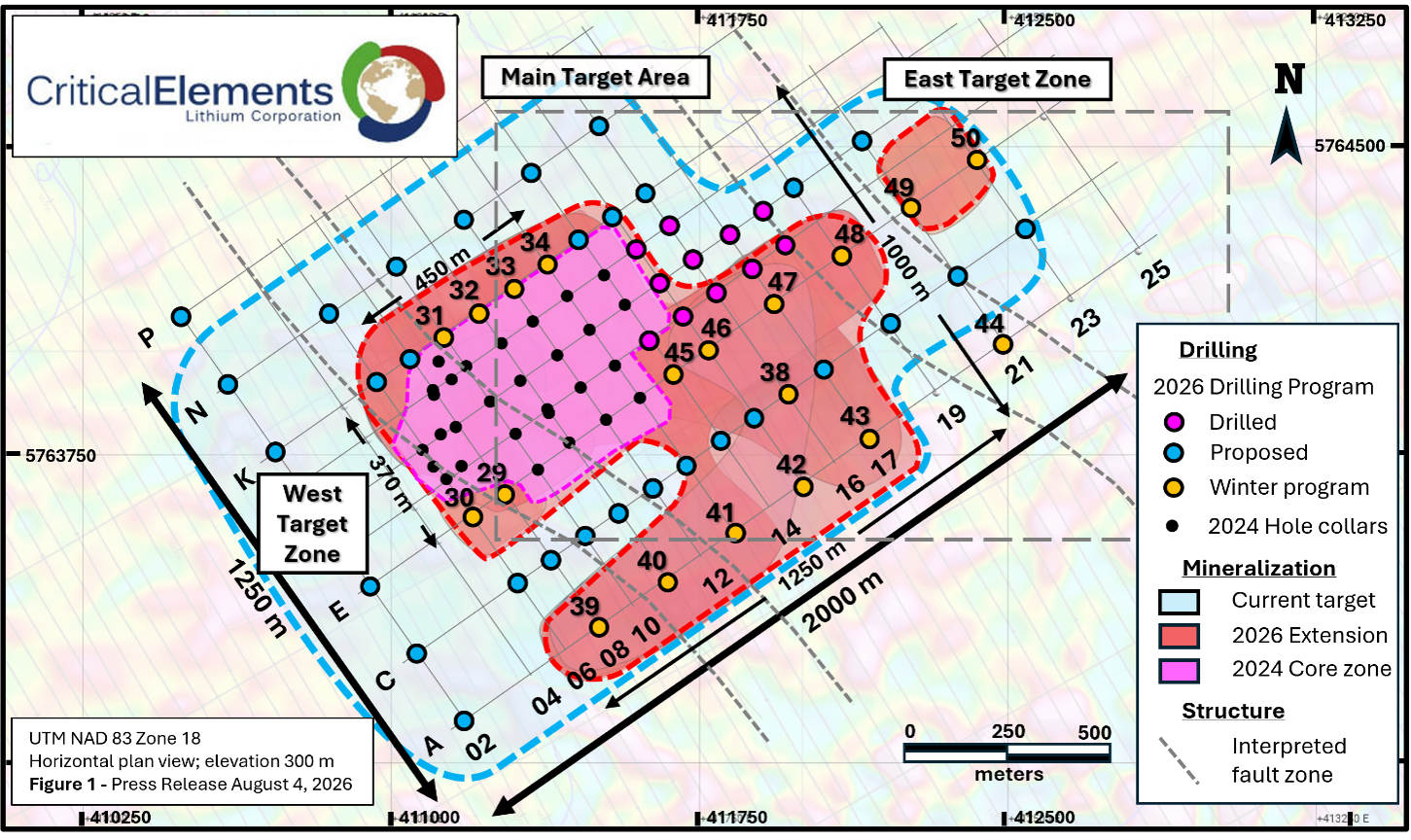
To date, eleven (11) holes were drilled in the NE corner of the Main Target Area for a total of 2,073 meters. Figure 1 below shows the location of these holes, which are designed to intersect all three principal pegmatites, i.e., Pegmatite 5 (new), 3 (Main), and Pegmatite 2. Table 1 below presents the collar coordinates, the planned length and the orientation of each of the holes drilled to date.
The Corporation has deployed two drill rigs to optimize the duration of the program. The drilling strategy is straightforward: based on our current geological model and interpretation, apply a 100 m grid approach to grow the known mineralized volume from its current boundary outward. The program targets the expansion of the mineralized footprint to a potential of approximately 1,250 x 2,000 m and could confirm the addition of at least two (2) more mineralized pegmatite bodies within the system.
Drillhole | Grid | UTM NAD 83 ZN18 | Length | Azimuth | Dip | |
Position | Easting | Northing | (m) | (°) | (°) | |
RW-26-35A | G-14 | 411,629 | 5,764,025 | 171 | 245 | -72 |
RW-26-36 | G-15 | 411,711 | 5,764,082 | 207 | 245 | -72 |
RW-26-37 | G-16 | 411,793 | 5,764,140 | 204 | 245 | -72 |
RW-26-51 | G-17 | 411,874 | 5,764,197 | 192 | 245 | -72 |
RW-26-52 | G-18 | 411,956 | 5,764,254 | 189 | 245 | -72 |
RW-26-53 | H-18 | 411,899 | 5,764,336 | 195 | 245 | -72 |
RW-26-54 | H-17 | 411,817 | 5,764,278 | 201 | 245 | -72 |
RW-26-55 | H-16 | 411,735 | 5,764,222 | 201 | 245 | -72 |
RW-26-56A | H-15 | 411,653 | 5,764,164 | 195 | 245 | -72 |
RW-26-57 | I-15 | 411,596 | 5,764,246 | 90 | 245 | -72 |
RW-26-58 | I-16 | 411,678 | 5,764,303 | 201 | 245 | -72 |
Table 1 - 2026 Summer drillhole locations and summary descriptions.
Drillhole | From | To | Length | Li2O | Ta2O5 | Zone |
(m) | (m) | (m) | (%) | (ppm) | ||
RW-26-35A | 86.95 | 90.50 | 3.55 | P.R. | P.R. | 5 |
104.55 | 131.90 | 27.35 | P.R. | P.R. | 3 | |
152.40 | 161.50 | 9.10 | P.R. | P.R. | 2 | |
RW-26-36 | 87.45 | 95.15 | 7.70 | P.R. | P.R. | 5 |
123.80 | 147.15 | 23.35 | P.R. | P.R. | 3 | |
RW-26-37 | 99.90 | 113.15 | 13.25 | P.R. | P.R. | 5 |
139.30 | 161.70 | 22.40 | P.R. | P.R. | 3 | |
189.35 | 195.30 | 5.95 | P.R. | P.R. | 2 | |
RW-26-51 | 97.30 | 103.75 | 6.45 | P.R. | P.R. | 5 |
130.80 | 148.85 | 18.05 | P.R. | P.R. | 3 | |
RW-26-52 | 112.40 | 121.20 | 8.8 | P.R. | P.R. | 5 |
129.10 | 148.50 | 19.40 | P.R. | P.R. | 3 | |
RW-26-53 | 115.00 | 126.00 | 11.00 | N.S | N.S | 3 |
RW-26-54 | 108.60 | 128.10 | 19.50 | P.R. | P.R. | 3 |
RW-26-55 | 140.10 | 148.20 | 8.10 | P.R. | P.R. | 3 |
RW-26-56A | 95.80 | 110.60 | 14.80 | P.R. | P.R. | 3 |
122.10 | 137.60 | 15.50 | P.R. | P.R. | 3 (?) | |
RW-26-57 | 45.00 | 63.70 | 18.70 | P.R. | P.R. | 5 (?) |
RW-26-58 | 57.05 | 71.10 | 14.05 | P.R. | P.R. | 5 (?) |
* Core length; the true thickness is between 80 to 95% of the core length.
** P.R.: Pending Results, N.S.: No Spodumene.
Table 2 - Spodumene-rich pegmatite intervals and assay results from the Summer 2026 drill campaign.
As previously discussed, the stacked nature of the mineralized system allows for the intersection of multiple pegmatite bodies within a given drillhole (Table 2). While keeping the same "grid-based" systematic approach, not all drillholes are anticipated to intersect each pegmatite. Figures 2 to 4 present plan views of the individual pegmatite zones as defined in the Winter 2026 program, as well as the nature of each intersection through the given zone.
Figure 2 is a horizontal plan view on which the projection of Pegmatite 5 is presented. All holes that were drilled on Line G successfully intersected Pegmatite 5. Holes RW-26-56A and -55 on Line H, also intersected Pegmatite 5, although the zone is less strongly expressed. Holes RW-26-58 and -57 appear to have intersected either a new stacked zone, or they could have intersected an offset equivalent of Pegmatite 5 or 3; interpretation of this sector is underway.
Figure 3 presents the Pegmatite 3 plan view projection. Most of the holes intersected the Main pegmatite, confirming its continuity across Lines G and H. However, a major fault has also been intersected in holes RW-26-53 and -55, likely explaining the absence of Pegmatite 3 on Line I in holes RW-26-57 and -58.
Figure 4 presents the Pegmatite 2 longitudinal view. Pegmatite 2 is confirmed to be present towards the central core of the mineralized area, and as predicted by our 3D model, it appears to get cut-off or merge into Pegmatite 3 towards the north. As a result, Pegmatite 2 was only intersected in holes RW-26-35A to -37.
"So far, the Summer 2026 drilling program is well engaged, providing the data needed to optimize the growth potential of the various mineralized zones and increase the level of confidence in our 3D geological model. Given the success of the current drilling program, we will therefore continue to further test the extent of the zones in all directions. We are hopeful that the program will demonstrate the continuity of not just one, but several lithium- and tantalum-rich pegmatites that are confirmed to date. Lastly, from a wildfire perspective, we are